Crossing Alicante – Club Náutico Tomás Maestre
Two years in San Gabriel ended with a crossing that almost didn't end well. We were ready for something new — two years of getting to know the boat, of working aboard the Azul, and slowly settling into this new life at sea, though, as she told me later, we had practically stopped sailing. The Azul made that clear.
We set sail at night; Juan came along. The plan was to arrive before the final hours of the following day — how naive!
There were three serious mistakes and maybe another I've since forgotten.
I put it in reverse: the Azul fell hard to starboard, which helped us clear the marina lane. This time, though, she fell too much and seemed to lose power; we nearly got too close to the boat on our starboard side. Still, the short channel let us slip out. Clear, a little thrust forward to kill the momentum and face the harbor entrance — but something was wrong. The Azul had no power.
That was the second big mistake: I should have reversed and gone back to the berth. Inexperience has its price.
The engine sounded fine. But there was no thrust. It took us a while to figure out what was going on, but we soon realized: the propeller wasn't pushing. Something was wrong with it, and of course the likeliest culprit was cavitation — the prop was sucking air instead of water, it had lost all its bite. It felt like we had a beach ball down there instead of a propeller.
That was the first big mistake: never leave port after a long stay without a thorough check of the propeller.
But we were already in open water. The night was calm — fantastic, I'd say — so calm there wasn't a breath of wind. Under power, the Azul couldn't make more than one knot. There was no point forcing it; we started drifting, floating, and we'd float for hours between Alicante and Tabarca, going neither forward nor back.
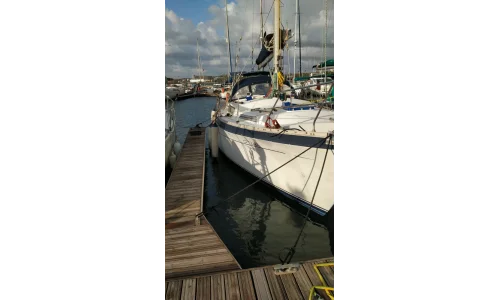
Night gave way to day, and there we still were, between the island of Tabarca and the port of San Gabriel. Time to make a call. The weather report said favorable winds would settle in over the course of the day. Our options: head back to San Gabriel, or try to catch the wind and make it to La Manga — and figure it out from there.
We called Tomás. He quickly shot down the second idea:
—Don't even think about it! The Estacio channel has currents that can reach up to four knots; you can't enter without propulsion.
So: back it is. We contacted some divers in San Gabriel to clean the prop, but they wanted an absurd amount for the job. So by noon, as the wind started picking up, we still had no plan. A light breeze began to blow, and finally we could move. That's when Jesús called:
—Head to Santa Pola. Don't go back.
The wind was favorable for Santa Pola, so that's what we decided. The Azul started sailing and carried us easily on that course. I should also mention that one of the options we considered was trying to clean the prop at sea. The day was calm and sunny, but it was February and the water was cold — and we had no wetsuit on board. Another mistake.
By mid-afternoon we were approaching the entrance of Santa Pola harbor. We called the local yacht club; we warned them we had very limited steering, and they told us to head for the fuel dock — the simplest route: from the entrance, a straight line to the mooring.
Right at the entrance, we dropped the sails. With barely any push, we crept slowly toward our destination. Docking was easy, perfect. It had been a rough stretch, but it was ending well. What more could we ask for?
Here's my third big mistake: the harbor crew told us we couldn't stay at the fuel dock — we had to move to a berth. They pointed out the easiest one from the dock; it really did look simple — go forward a few meters and take the first lane to port, first finger on starboard, almost in a straight line.
We had our doubts, but it seemed doable. I should never have moved the Azul. I should have asked for help. Without momentum we had no steering, and this was the most treacherous moment of the whole crossing — because I thought I could handle it.
The Azul wouldn't steer. Impossible to turn to port or anywhere. The wind pushed us, drove us toward the end of the harbor. I watched the breakwall getting closer and I knew we had reached the limit of our luck.
I slammed it into full reverse. The Azul fell to starboard, picked up a little momentum, and slid her stern into the wide corridor between the yacht club and the marina opposite. I let her drift backward. She was steering. Holding course. At first there was an empty berth, but we were entering a narrower lane with docks on both sides. Neutral. The Azul kept moving backward. Slow. Straight. When our bow passed the empty berth, I threw it into forward, hard, with the wheel hard to starboard. Barely moved. But the bow turned toward the right spot, and slowly, a small inertia carried the Azul into the open slip. Gently. Docked.
We ended up in the marina across the way with people we hadn't spoken to. We went to the office and explained our situation. They were very kind — they told us that berth was taken, but they'd move us with their launch (exactly what we should have done from the fuel dock), and they had a diver they'd send over in a few hours.
It was tense. We could have ended up against the breakwall or into another boat. Nothing happened — we docked cleanly, by some miracle. But these mistakes can't happen again. This isn't a game.
We spent a quiet night in Santa Pola. The diver showed up in the afternoon, a friendly kid in his twenties; he said he'd come back in the morning, so we relaxed and went for a walk around town. A neighboring city we knew well — a couple of beers and dinner on land, absolute luxury.
The next day, the diver got to work; he was at it for a good while. He cleaned the propeller and worked on the rudder a bit; he showed us videos of how it looked. Yeah. It looked like a beach ball. Unbelievable.
By the time he was done it was noon, so in the end we stretched it to another night in port. We planned to leave early and make it to La Manga that same day, so we took one last walk around town and went to bed early — we'd set sail before dawn.
The next day, still dark, we cast off. The Azul was herself again — she maneuvered perfectly, confidently. We left that unplanned stop behind and set course for our berth at Tomás Maestre. This time, without incident. By late afternoon, just before dusk, we were at the entrance to the Estacio channel, waiting for the drawbridge to open, careful not to enter it.
It was our first time. The bridge lifts on the even hours between 8 AM and 8 PM — in summer they extend the hours a bit, I think — and you have to stay on the radio; another mistake would be entering the channel too early, where maneuvering is tight. Everything went well. Before sunset we were at the harbor entrance, and a massive school of fish swam beneath us, almost like a welcome.
A small crossing, made complicated by my mistakes. In the end, everything turned out fine, but at sea things can get ugly on their own — and what's in our control can't afford to fail like it did this time. A lesson learned, no doubt — though I wouldn't have minded skipping it.
Finally docked, Jesús and Tomás were there to greet us. Thank you for your invaluable advice.
Epilogue: Three Years Later
After a few days on land, my mind relived every moment of that crossing. It was a bad crossing, yes — but it could have been worse. Luck, or fate, saw to it that it all boiled down to a hard lesson and a story to tell.
I'm writing this three years later. We've gained experience without losing an ounce of respect for the sea — if anything, we've deepened it. We still spend long stretches in port, not as long as in Alicante, but long enough. It's become a ritual for me before setting sail: I put on my wetsuit and check the Azul's underside. Unexpected things still happen, and they always will. But now, the propeller is always clean.
Note from the crew
This English version was translated automatically using small, local AI models during our voyage, often without an internet connection. It may contain small errors or quirks. The original Spanish version is the definitive one. We appreciate your understanding — and if you speak English and spot something that could be improved, we'd love to hear from you.