La Manga
We’re from Alicante, not too far from La Manga, but it was always a place off the main route. Perhaps the fame for mass tourism, urban sprawl, I’m not sure, but it always gave us a bit of resistance. It wasn’t a place to go—at least for some Levantines. Yes, I suppose they could call it prejudices.
It’s true we never thought of ending up here with the Azul, but various circumstances led us here. The first was Jesús, our neighbor on board at San Gabriel. He arrived there before us and spoke kindly to us. We also had a haul-out pending, and it was already almost certain it would be in Torrevie, at least a boatyard that allowed us to work. San Gabriel’s port also underwent a directional change, and drastic changes in the port didn’t fit with our plans.
The point is, in February 2024, we arrived at the Tomás Maestre port, a port located in the Estacio channel, right between the two seas. We still remember the entrance—a massive school of fish accompanied us to our assigned mooring. We had never seen such a thing in a port, and until now, we haven’t seen it again. The signals were good. Jesús welcomed us from the bridge and gave us time to reach our mooring to help us dock alongside Verónica, the port’s mariner who became a new friend. We couldn’t ask for more. However, Tomás also appeared, an old family friend, with whom we would form many bonds during our stay.
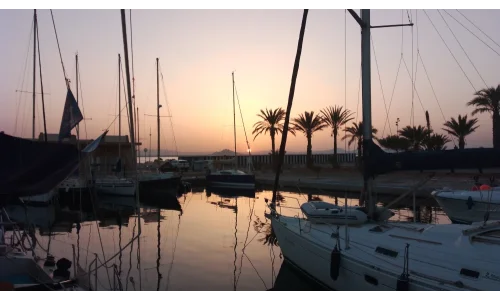
It was winter. La Manga is a tourist town, and in winter it’s empty, only those who live there year-round remain, and they aren’t many. It’s striking, with many buildings and a somewhat ghostly appearance. It’s a special place, a tongue of land that almost connects from the south Cape of Palos to the north, San Pedro del Pinatar. I say almost because they aren’t connected. A narrow strip of land separates the Mediterranean Sea from the Mar Menor, with a single road over 20 km long, they say the longest street in Spain. You enter La Manga from the south and leave through the south, a dead-end road.
We arrived with prejudices that began to crumble the moment we touched land. Our mooring was fastened to the western breakwater, next to the Mar Menor, and soon we discovered a chiringuito, 50 meters from the Azul, where the most beautiful sunsets we had ever seen awaited us, and it provided the link with the inhabitants of La Manga, who became great friends. Elayne’s chiringuito, she—Elayne, a brave, cheerful, and witty woman who welcomed us from the start.
There, we met Carlos and Seline, the Madrileño and she, a Frenchwoman, neighbors in the port and both expatriates in La Manga, living at the end of the longest street, where you can’t reach unless you have something to do. Neighbors to each other. A special bond grew between us. They live in a paradise, they know it, and we began to learn it.
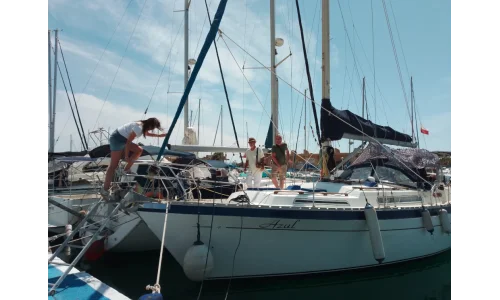
Then there are the port residents, those who live on the boats. The Tomás Maestre is a big port, and there are some, Paco from the "Yuluka," Carlos from the "Agrado," or Perfecto and Zoraida from the "Zoper"—these last ones were passing through, continuing their journey across the Adriatic today, but they stayed long enough to share a few laughs with us.
It was a chaotic, wild, and genuinely fun time. There was always someone to grab a beer or take a walk along the shore, but it was also a period of work on the Azul, the Volvotor phase. First, we sought out the official Volvo mechanic to replace the belts, but I wasn’t ready for that yet, and they did it poorly. Buff, they only messed up the engine, but it could have been worse. An official Volvo Penta dealer in Cartagena and not cheap.
The turbo wasn’t working, so we had to replace it—it was done by us, with the help of Carlos and Paco. It’s still working, and I no longer dared to touch the Volvo parts. The Exhaust Elbow, a deep rehabilitation where they also helped us.
On the other side, Tomás helped me with the guardrails and the tiller’s cable, a review and maintenance, a latent fault that we could solve. He helped with many things, with the sails, contributing his experience and wisdom at sea, a navigator for many years, and it was clear. Naturally, we always found time for a few "Chelitas," and we enjoyed many moments already woven into our lives forever.
Impossible to recount everything—it was an intense period that transformed us, months well-spent in every aspect and that brought us new, wonderful people. All of that we took from there, how could we leave it?
In August, we left the port but didn’t break ties. We went to the Mar Menor to spend a few days anchoring, but this is part of another story, which we’ll recount when we’re back.
Our eyes remained filled with sunsets.
Note from the crew
This English version was translated automatically using small, local AI models during our voyage, often without an internet connection. It may contain small errors or quirks. The original Spanish version is the definitive one. We appreciate your understanding — and if you speak English and spot something that could be improved, we'd love to hear from you.