Melilla, distant and lonely.
We arrived in Melilla in mid-May of 2025; it attracted us because we had never been there. Unlike Ceuta, which was many times a stopover on the way to Morocco, Melilla lay far away.
We came from Almerimar. A complicated crossing: barely 130 nautical miles, but the engine gave us problems; to put it plainly, the diesel did. "Volvotor" had no fault, but the annoying diesel bacteria, though this is a story for another entry.
We wanted to come directly to Melilla from La Manga, but they wouldn’t grant us passage in the port: they told us there was no space, which led us to Almerimar, where we spent the previous winter. In spring, they confirmed we had free space, and when the weather permitted, we went there.
Melilla was a discovery in every sense. It is a particular city; its geographic and political situation makes it different. It is not a city like those of the peninsula, and little by little we were going to discover it. The first walk, between the adrenaline and the euphoria of the journey, led us to tour and start to know its hidden corners.
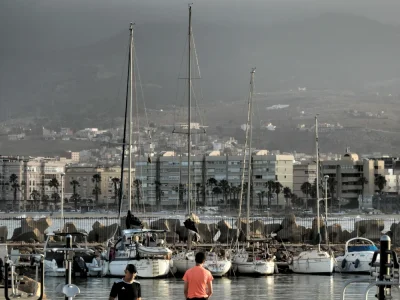
What caught our attention was hearing what was spoken in the streets. It was striking to hear both Spanish and Tamazight equally, with the latter even more prevalent. At first, we thought it was Arabic, but as we learned more about the city, we discovered it was incorrect: Tamazight is the language, the Berber of this northern African region. Calling it Arabic is like calling Swedish Spanish.
It was logical to think it was so, but no one had told us. Personally, it struck me quite a bit. Accustomed to the peninsula, where news comes of serious problems of coexistence, racism, or disgraceful episodes in some towns against the immigrant population, it was interesting to learn a bit more about what was happening there.
As night fell, already back on the Azul, that first day we began to hear the call to prayer from the muecín. We’ve always liked hearing it when traveling to Muslim countries, but this time it came as a surprise: not expecting it in a Spanish city, and I liked it.
Our journey through Melilla had just begun, and it already gave us sensations we hadn’t expected. The city, by itself, promised: its ancient citadel, very well preserved, a witness to other times and important events; its old, noble quarters, contrasting with the lively and popular neighborhoods, scattered with small shops and mosques; mint tea, and the churros. Yes, the churros: Melillenses adore them, and it’s rare to find a café that doesn’t serve them, for breakfast or a snack, at any hour you want.
A lot of police and military visible in the city, many monuments and streets named after military figures. Everything seemed to indicate a complicated mix, but only seemed so. Again, it wasn’t the reality, or at least not what we could discover as we went.
And the border, the gate to another country, another culture. On the other side awaited Nador, Saïdia, Oujda, Alhucemas… I’ve always thought it fortunate to live near a border that takes you to another place, and if it’s a different culture, even better. Melilla confirmed it for us. The Moroccan northeast, a total unknown for us.
Soon we met our neighbor on the boat and friend, Hilario. We formed a quick connection, and all our stay in Melilla won’t be remembered without thinking of him. We shared talks, laughter, drinks, as well as anecdotes and experiences reserved for ourselves three. 76 years old and like a kid, living on a sailboat for a long time, and in Melilla, I believe, almost 20 years.
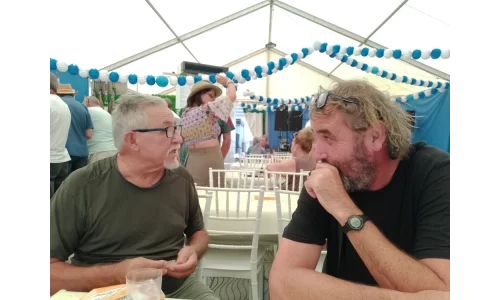
Days began to pass and a routine established itself, the normal routine of anyone living in a place. The initial sensations were calming and being absorbed. It had already become absolutely normal to hear Tamazight on the streets and the muecín. And an idea growing in us was becoming more certain: harmony in the city. The two cultures living together and apparently without friction. I don’t say there aren’t any, but for us they weren’t visible. The Melillenses speak of four cultures in the city: it’s true that Jews and Hindus are also present, but really, although visible, they are minorities. When I speak of the coexistence of the two cultures, I refer to the Christian and Muslim ones, which are the majority of the city.
Perhaps the strongest idea we took away from there: that harmony and coexistence. Personally, I find it fantastic, and then it makes me wonder: what do we do elsewhere? It’s not that difficult! And also very healthy, for people and for society.
Our first trip to Morocco arrived: the border on foot. Although I like living near one, crossing them is never too pleasant. However, it wasn’t complicated nor too long. On the other side awaited the port of Nador and the bus line that would take us to the city for 5 dirhams.
Nador didn’t promise an ancient medina; it was a relatively modern city, and, at risk of being wrong, urbanistically developed or promoted by the Spanish not too long ago.
It’s true that it’s not a monumental city; it’s more leaning toward being ugly, some would say, but we liked it a lot. A large city, at times chaotic and always full of people going everywhere. At the edge of the Mar Chica, an interior sea twin to the Mar Menor in Murcia. Fish in every bar and many Spanish-language posters from other times. A stone’s throw from Melilla; in an hour or an hour and a half, we made the trip, including waiting times at the border. It became a frequent destination for shopping or anything else, filling our passports with entry and exit stamps.
We spent the day there many times. And yes, McDonald’s also arrived here: every empire leaves its footprint wherever it goes; this one leaves these things.
While Oujda remained at the back of our minds because the summer heat was already pressing, we received a visit from Javier and Carmen. With them, we went to the beach, to the easternmost part of Morocco, close to the Algerian border. Saïdia is a modern city focused on its own tourism. We went in full summer and felt and heard it: high prices and music until late hours.
The beach, spectacular: kilometers and kilometers. The apartment area, to be honest, doesn’t have much to say, although we never forget we’re in another culture and it always has its charm. A couple of nights we stayed and decided to go to a small fishing village, Ras el Ma, much smaller and calmer, with a nice landscape. On the way, we visited the marina of Saïdia, a large and rather empty marina. For a while, we thought about coming to spend a season with the Azul, something we ultimately didn’t do. It’s true that it’s in the middle of an urbanization and a bit far from the village; without a car, everything is more difficult.
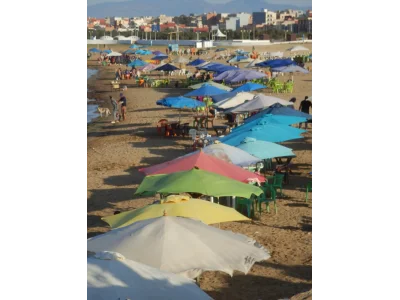
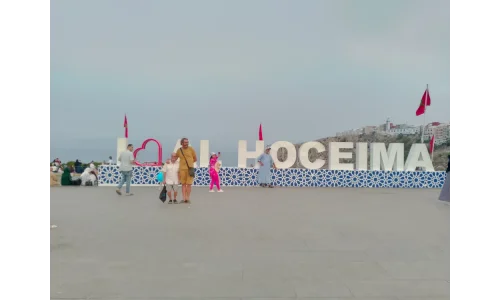
Time continued to pass. Melilla, connected to the peninsula by two daily boats—one to Málaga and another to Almería—the umbilical cord, seems fragile but it’s there. It also has an airport, but it’s flights by small planes and not cheap. Through there entered a second visit: Gaspar, a lifelong friend. And how could it not? It was another trip of a few days to Morocco, this time toward the west: Al Hoceima, a vibrant and modern city perched on a cliff over the Mediterranean. We loved it, its people and its energy. We sensed subtle but real movements of independence among the Rif people; some graffiti on the walls of the streets betrayed it. I hadn’t seen these things in Morocco in the western part; here there are other concerns. But the city always showed us its friendly side. It was easy to understand us in Spanish, and that’s an advantage. A surprising city we want to return to.
The months passed quickly. Friendships were formed that remain still. The fuel of the Azul occupied a season: filtered, tank cleaning, treatment, new emergency bypass in case of anything and new water separator, which was the one that gave us problems in the crossing of arrival.
But not everything was the routine of the boat. Over time, we began to understand that Melilla also had wounds. The politics, both from the Spanish and Moroccan sides, hurt the city. Today only an open border remains, and the commercial border was definitively closed after the pandemic. Those lines of women with bundles passing to trade, which we had so often seen in photos and documentaries, no longer exist. Many closed businesses explained that it was a consequence of that closure. It hurt them, but it didn’t kill them. Possibly it’s more Moroccan will to pressure what they consider theirs. It’s a delicate issue, I know, but Melilla has much history and it doesn’t deserve to have what it has lost forgotten.
And despite all that, the city continued to live. It continued to be that rare and wonderful mix that captivated us from the first day.
The moment to leave arrived. Hilario bid us farewell. He released the Azul’s lines with those hands that have tied so many knots. The farewell was emotional. Also present were Jose and Parsi, a Gallegan and a Filipina, a couple, who had arrived in Melilla last month. Together, among laughter and some silence, they sent us out to sea.
And then, as Melilla disappeared on the horizon, I knew it was no longer the same distant place we arrived. Now it was a distant place inhabited by the echo of Tamazight, the smell of freshly made churros, Hilario’s laughter at sunset, and that muecín, from the other shore, still reminding me that coexistence is not a dream, but a real possibility.
The end of the journey remains to be written, but perhaps the end is this: to keep sailing with the certainty that there are places, even within Spain, where the world is understood in another way. Melilla taught us. And for that reason, now I write it.
Note from the crew
This English version was translated automatically using small, local AI models during our voyage, often without an internet connection. It may contain small errors or quirks. The original Spanish version is the definitive one. We appreciate your understanding — and if you speak English and spot something that could be improved, we'd love to hear from you.