Ceuta to La Graciosa Passage
We departed on May 20, 2026, at 07:20 and arrived in Caleta de Sebo on May 26 at 12:00. 583 nautical miles in six days. We had planned to leave Ceuta on the 12th. Our contracted berthing time was up, and Juan had arrived on the 9th with that idea. However, a persistent westerly wind in the strait tied our hands. We had spent days waiting, and the marine forecast did not call for easterly winds for at least a week. We hesitated: was it prudent to depart against the wind? After all, it was only a few miles to Cape Espartel, and once crossed, the winds would blow in our favor. Yet the strait does not forgive: strong currents, eddies… if you don’t know how to read them, you can end up sailing backward. Even more so with the wind at the bow. We decided to wait. Thanks to the Marina Hércules in Ceuta, which kept our berthing rate during the delay, we could maintain calm without economic urgency.
Another concern was the orcas. At this time of year, they follow the tuna migration toward the Mediterranean to spawn; some call it the largest protein movement on the planet. The point is that in recent years, interactions with small vessels, many sailboats, have caused damage to rudders. This could end in a serious safety issue. We spoke with local groups, mostly from the peninsula, and all advised us to cross the Spanish side and coast there. However, the attacks continued: one day yes, the next no, but often, and all of them were on the Spanish coast. None on the southern coast of the strait. We didn’t understand the advice; it justified the greater number of boats on the northern coast, but it didn’t convince us.
Days of uncertainty passed. We even considered abandoning the crossing to Canarias and returning to the Mediterranean. It wasn’t a failure, but we hadn’t charted a clear route, and that generated anxiety. It was our first real oceanic passage, and the mind never rested. Day after day, the westerly wind blew like a sandglass, giving me time to review the known and the unknown. A silent dialogue between my doubts and the sea.
The questions covered everything: the boat, my preparation, our ability to respond, the orcas. We had just resolved a serious fault in the instrumentation; a crushed cable had us stuck until we found the exact cut point. Would everything work at sea? Canarias is far. What would we do if something failed there?
Time passed, and as an unexpected gift, it gave us the margin to visit Tangier. At least it was. Perhaps fate didn’t want us to cross without knowing it first. A city with character, the kind that asks you to return.
In those final days in Ceuta, we met Giuseppe, an Italian who had just arrived from Greece in a six-meter sailboat. A seafarer, calm and determined. He too awaited the easterly winds. His plan was Tangier, then Madeira, alone. Characters like him aren’t found in any port; the sea attracts and selects them.
In the end, we departed together. He went first, we followed. He had a small outboard motor that he only used to leave the harbor; the rest, by sail. We raised the mainsail; with little wind, we used the motor as support. We had studied the currents: after the high tide at Algeciras, two or three hours later, an outgoing current sets in, pushing toward the Atlantic. It worked for us. The Azul flew in segments: 8 knots, 9 knots. Giuseppe followed our wake without losing distance. We were coasting along the north coast of Morocco.
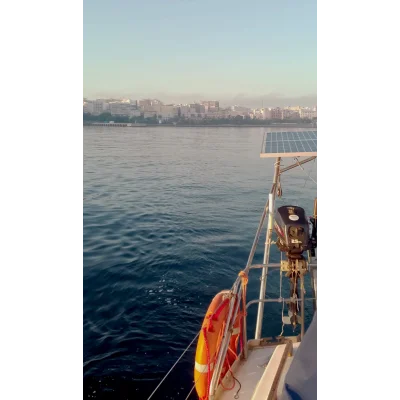
We crossed the strait faster than expected. We rounded Espartel after 14:00 and cut the engine. No significant traffic. No orcas. A wind that intensified from land pushed us at a good pace for hours. And with it came some unexpected visitors: a cloud of Moroccan flies. Suddenly, the cockpit and deck were filled with insects. We left Ceuta clean and appeared infested. The flies bit: they bit Juan even through his clothes, and Eli and me too, though it wasn’t as bothersome. Without insecticide on board, our defense was patience and a flyswatter. A anecdote that some will remember better than others: the attack at Espartel.
Giuseppe took his first peek at the Atlantic. He had said he wanted to see it, but at first, we were confused; we thought he had abandoned the stop in Tangier. However, he made a couple of tacks and returned to the city.
In the afternoon, the wind veered to NE. Our heading was SW, so we had it from the stern: mainsail open with a good vang, no genoa. I still need to acquire a whisker pole, but the Azul responded well, maintaining 4.5–5 knots. A swell entering through the starboard quarter occasionally rocked us, but the navigation was clean. Everything I had heard about this route said: raise the sails and don’t touch them until Canarias. I thought it would be the case. I was wrong.
That favorable wind lasted only 24 hours. The next day, it veered to SW, directly head-on. The passage became more demanding: we turned on the motor and didn’t turn it off until the next day. It accompanied us intermittently for most of the crossing; this was the longest segment, 24 hours straight, but afterward, it would be a point-to-point ally.
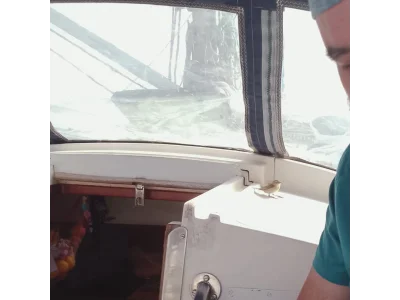
Thus passed the days: long hours at sail, motor segments, and fog. On the second day, before sunset, an unexpected stowaway arrived: a small bird. Likely a migratory bird diverted by the winds, it sought shelter aboard when we were about 20 miles from the coast. It was unusual to see it so far from land, but the Atlantic sometimes plays with the limits of expectation. It feasted copiously, devouring hundreds of dead flies in the cockpit. As dusk fell, it retreated to the cabin and took refuge in the aft cabin. We believed it would accompany us until the end. The next morning, it woke up, rested a moment on the chart table, and, exhausted, closed its eyes. A shame. But it spent its final hours in safety, with food and rest. Who knows how long it had been flying against the wind that pushed it into the ocean’s interior.
On the third day, before sunset, another visitor arrived, this time unwanted and persistent: fog. Its first visit began at 21:00 and lasted until 04:00. Thick, visibility under 50 meters. That night, it disrupted my watch and my rest. No forecast had announced it, not even the VHF coastal stations we occasionally tuned in. I suppose for commercial navigation, it isn’t a priority. For us, it was.
The rest of the journey was a rhythm of following winds, motor segments, and banks of fog appearing without warning. The lack of visibility mentally exhausted us, though the AIS kept us informed of nearby contacts. Fortunately, there was no heavy traffic or real risk situations, but sailing blind never leaves the body at ease.
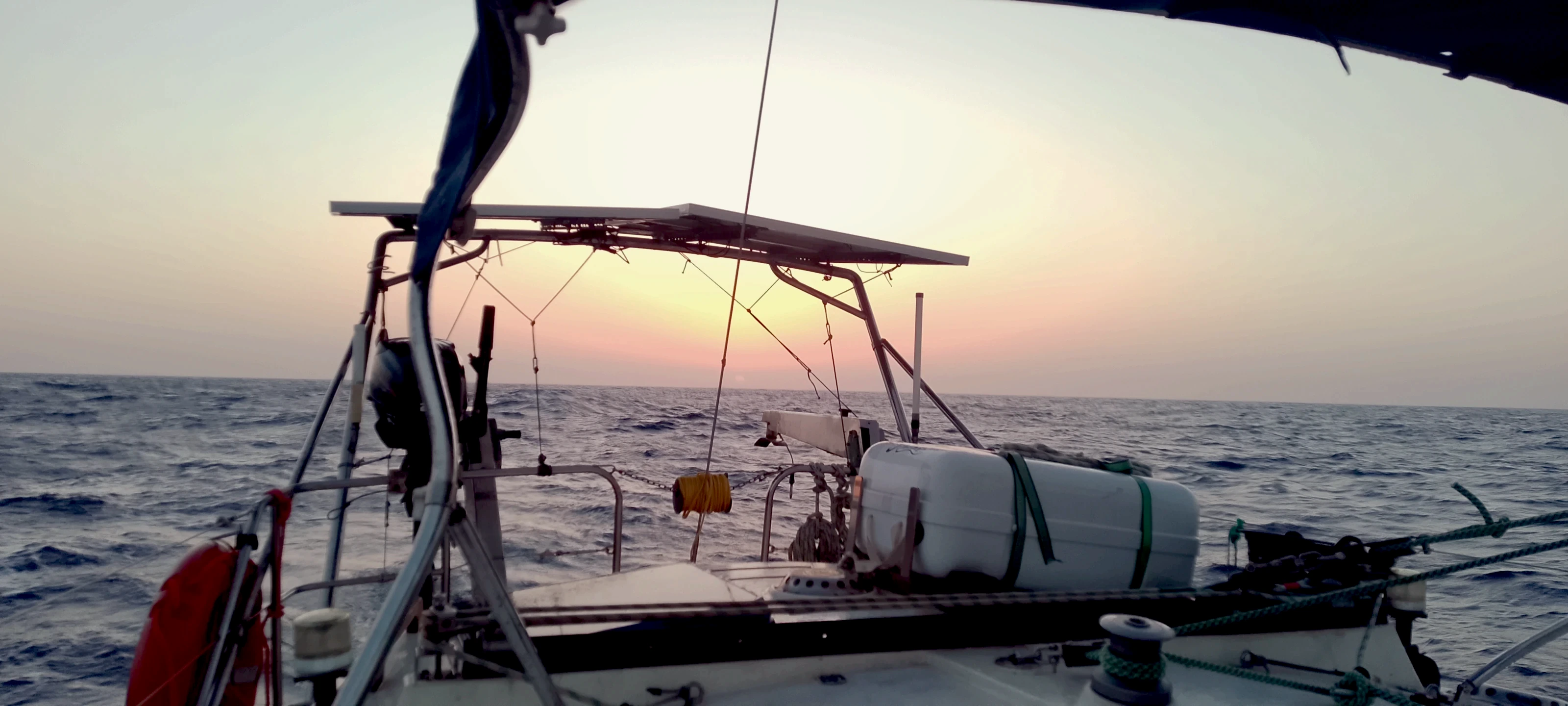
The autopilot performed without a single stumble. It guided the Azul for the full six days, except for brief moments when I took the wheel. The human crew didn’t touch it at all. Serán gandules!
At sunset on the fifth day, we were 25 miles from Lanzarote. We were sailing on a beam reach, 4–5 knots, and calculated to arrive at La Graciosa at night. It didn’t excite me, but the impatience to touch land weighed heavily. With charts and estimates, we could have arrived, but before nightfall, the fog returned, dense and frustrating. We decided to reduce speed. Perhaps at night, but at night with fog, I wasn’t sure about entering the port. We lowered the genoa, left only the mainsail, and the speed dropped to 2–2.5 knots. We sailed like this until dawn, when the fog lifted and returned the horizon.
On the sixth day, we awoke 12 or 13 miles from Lanzarote. On the horizon, the rock on the east, and shortly after, the unmistakable profile of the island. The wind fell again, so the last hours were by motor. We wanted to arrive. Though the final miles were suitable for sail, perhaps the last five, we kept the motor running. We had one hour or an hour and a half left and only thought about arriving.
Around 12:00, they gave us passage to Caleta de Sebo. We docked without issues. The landscape left me speechless: a harsh, luminous, and silent place. Tired, but with a smile on our faces. A can of beer to celebrate, once the Azul was moored and before the entry paperwork. We almost delayed with the procedures, but everything closed smoothly.
The Azul didn’t fail. The motor, the autopilot, the sails, the bilge dry. The fears from Ceuta, once again, were unfounded.
We’ve spent a few days in La Graciosa. Juan left by plane for Mallorca. We stayed for a while, without a closing date yet. But that’s another story, and you know: the sea only tells it when we’re ready to listen.