Ceuta, Between Two Continents
We arrived in Ceuta in mid-November 2025, after our stay in Melilla. A day-and-a-half crossing brought us to the Strait’s threshold; this time, a calm crossing. The cleaning of the diesel and the tanks we performed in Melilla was effective.
Initially, our plan was to stay until the start of spring and then set sail toward the Canaries. In the end, the stay was prolonged by various circumstances. The first, of course, was the weather, which remained quite variable by March and, in the Canaries, even unusual. However, Ceuta also became a stop we used to leave the Azul alone and return home during the holiday season. That escape extended beyond expectations, with us staying in Alicante for almost two months.
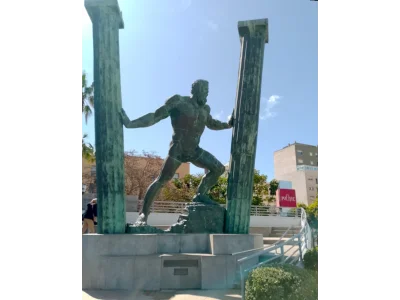
Ceuta was perhaps one of the stops where we passed unnoticed. Perhaps we didn’t mingle too much with the locals, but we explored it fully and enjoyed its landscapes, which are truly spectacular.
The city is built on a small peninsula that juts into the sea, meaning it has two sides. The northern side faces the Strait: it is where the port lies and from where you can perfectly see the Rock of Gibraltar and the Algeciras Bay through the intense maritime traffic. The southern side faces the Mediterranean; here are the beaches, and the profiles of the Moroccan coast are visible: Fnideq, the first village across the border, known as Castillejos (many Moroccans still refer to it by this name). From where we were anchored to the southern side, the central market of Ceuta and barely 500 meters separated us.
Yes, Ceuta is geographically in a privileged location. Walking toward Punta Almina (east) shows you the entire Strait in its splendor: the views are spectacular. Or take a bus to Benzú (west), a small neighborhood on the edge of Ceuta’s borders, which takes you along a winding road that traverses the entire coast, delving into the Strait; its views are well worth it.
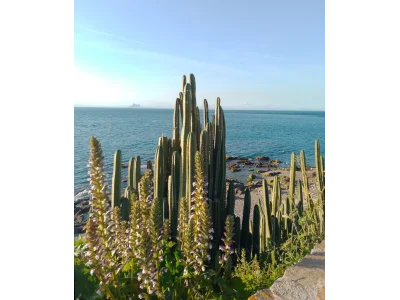
It has problems similar to Melilla: the same policy has stifled commercial exchanges across the border. However, the great difference is that it is just a few miles from the peninsula and you can tell. The ship traffic is intense; I don’t know how many per day, but a couple of dozens for sure, and this changes the city’s appearance: it seems less lethargic, more active. Additionally, it remains a stopover for many who jump from Algeciras with the neighboring country in mind. We ourselves have done this many times in the past.
And, just like Melilla has its gate to Morocco, and just like there, only one border remains open: the one at Tarajal. Across from it, Tetuán and Tangier await us.
Tetuán: Our Great Discovery
Easy to reach from Ceuta: cross the border and a shared grand taxi drops you near the center for 20 dirhams. Many times we had passed before, always leaving it behind on the way to Fez or Chefchaouen. It became our “new Nador.” The passport continued filling with entry and exit stamps, and the big culprit was Tetuán.
I can say we know quite a few cities in Morocco and almost all the more touristy medinas; perhaps Rabat is still missing. The medina of Tetuán is really beautiful, small and manageable, but real: the medina belongs to them and not to the tourists. May it remain so (inshallah). White and labyrinthine, it’s impossible to reach the place you intend on your first visit, at least for us foreigners. But it’s better: in that constant loss, you always discover some new corner that surprises you.
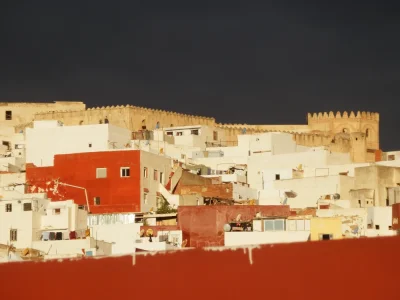
The atmosphere—this is something common throughout the country—is friendly with visitors. However, there’s something special in Tetuán, something that binds us and that one day separated us: Al-Ándalus is present here. They speak of it and recount it with nostalgia: “many of us came fleeing here.” The Horno Ibáñez, historic, since 1730. Traces like these are numerous and visible. The Andalusian Music Festival; pity we stumbled upon it by chance and couldn’t attend, returning to Alicante the next day just as it started. Courtyards and streets adorned with colorful pots and geraniums, so familiar...
Here, a violinist in a riad where we stayed (Riad Khmisa) played occasionally on the rooftop, and he played some chords that were the Spanish anthem.
— Do you know it? — he asked.
— Of course, — we replied.
— An Andalusian song, — he added.
There we discovered that the Spanish anthem has its origin in an Andalusian melody. Poetic and historical justice.
The colonial zone, adjacent to the medina, from the era of the Protectorate, of which Tetuán was the capital, is well maintained and has visible remnants of that time. The Plaza Primo is still called by that name, for Primo de Rivera. Yes, these dissonances exist and are visible.
This is one of the cities where emigrants still keep the keys to the houses they had to flee from on the peninsula centuries ago. However, there is no resentment, only nostalgia.
Between walks in Ceuta, escapes to Tetuán, and the maintenance of the Azul, the days passed. The departure date was approaching, and Tangier was getting further away; however, fate did not allow us to leave without visiting it. It was a short visit, too short, but we promise to return.
The little we saw and could intuit fascinated us: a modern city but with its roots clearly visible, right at the other end of the Strait, the gate of entry or exit, depending on your direction. It was the closure to our period in the northern part of the African continent, a closure that tasted little but left its mark.
Finally, the moment to depart arrived, and this time, a sailor from the Marina Hércules, our home for the past few months, bid us farewell. Thank you for everything, Ceuta.
Note from the crew
This English version was translated automatically using small, local AI models during our voyage, often without an internet connection. It may contain small errors or quirks. The original Spanish version is the definitive one. We appreciate your understanding — and if you speak English and spot something that could be improved, we'd love to hear from you.