Bound for Melilla: Between the Diesel Bug and Seasickness
El Azul set sail from Almerimar on May 12th bound for Melilla. On board, besides myself, were my partner Eli and my friend Juan, a seasoned sailor whose 67 years of experience would soon prove invaluable. The southwest wind (SSW) didn't allow us to sail, so we motored south, with a scrap of genoa and two reefs in the main, making between 4 and 5 knots.
After clearing the Strait shipping lane around 15:00, the first serious warning came: the engine stopped. I had changed the filters before leaving, so I thought it might be an air bubble. I bled it and it started. But that's where my other problem began: severe seasickness that was weakening me. The engine held for a couple of hours... and stopped again. My condition worsened every time I went down to the engine room. I bled it again, it started... and stopped once more. The diesel wasn't reaching the engine properly.
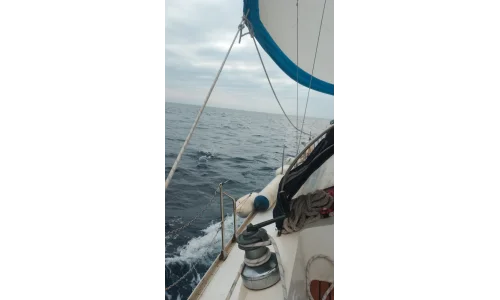
The engine started easily, which was a huge relief: it ruled out a serious mechanical failure in the block. We ran several tests, and with each one my condition worsened: just going down to the engine room was enough to send me rushing back up to hug the bucket waiting for me on deck.
We kept moving slowly, at 2 or 3 knots, and fortunately on a good heading toward Melilla. But our attempts kept failing, and night fell upon us. I was feeling terrible and needed to rest; in my state I couldn't do anything useful. I decided to try to catch some sleep. With daylight we'd still have time to keep trying, but first I needed to recover my body: the way I was, I was completely useless. At dawn on the 13th, around 05:00, I relieved Juan. My body seemed to have stabilized; the nap had been restorative. Storms loomed on the horizon. Another scare: the autopilot wasn't responding. "Seatalk Error." Rebooting the instruments fixed that problem, but it raised doubts, and I'd have to look into it as soon as I could — though the engine was still the priority. I made myself a coffee and it settled well; I ate some fruit, which worked wonders on my stomach.
During those critical hours, Juan brought a calmness and confidence that were essential on board. Thanks to him and to Eli, I could completely stop worrying about the course and maritime traffic. While I was fighting in the engine room or out of commission from seasickness, they took care of keeping the boat on the right heading and monitoring the navigation. Knowing El Azul was in good hands allowed me to focus all my energy on the mechanics.
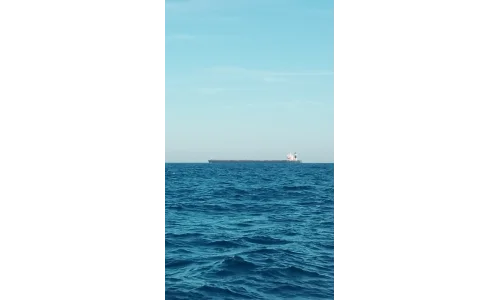
When Eli got up, around 07:00, I decided to attack the engine again. I changed the filter and pre-filter once more — which didn't look dirty. It started... and stopped. We checked the circuit. The hose from the pre-filter to the engine was empty. We tried everything: fuel flowed freely before the water separator, but the valve before it seemed clogged. I cleaned it... and it seemed like the solution. But no. The engine stopped again.
Each test meant stuffing my whole body into the engine room, over the engine — not the most comfortable position — but I had fully recovered by then, which allowed me to keep pushing on. I was worried about the battery: lots of starting attempts. But we have three battery banks, one of them unused, kept as reserve for the engine. Plus we have solar panels, so one way or another, electricity shouldn't be a problem. The day marched on relentlessly. It was almost 18:00 and we were less than 10 miles from Melilla. I'd spent the whole day going in and out of the engine; I didn't enjoy a second of the trip: I just stared at the horizon and the clock, hoping the engine wouldn't die. They were long, exhausting hours. Options were running out: sail in — which seemed complicated (though after getting to know the port, it would have been feasible) — head back to the mainland, or anchor, but these were unfamiliar waters and we didn't know where the right spot would be.
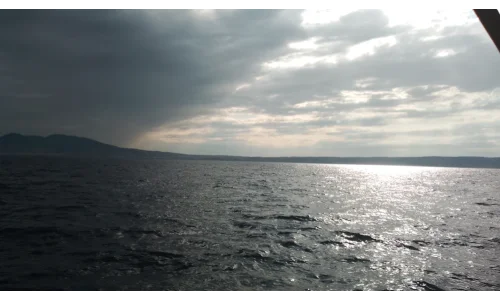
One last risky attempt remained: bypassing the pre-filter. I had to improvise a splice with whatever I had on hand. I was also worried that the debris that had clogged the pre-filter might reach the engine, although there was still one more filter before the diesel reached the engine — the standard engine filter. And we had no other options. Barely 5 miles from the breakwater, with my heart in my throat, I bled the system... and we started. "Don't stop," I thought with a knot of hope in my throat. And it didn't stop.
El Azul, and Volvotor, set course for Melilla. It was in sight. We called the port on the radio and asked them to take us straight to the berth; we didn't want to stop at the waiting dock, just in case. We explained the situation, and that's what they did. It was just one hour of sailing, and although we were all afraid, I think by then there was already confidence that it wouldn't stop. We docked without incident. El Azul, as if nothing had happened. We weren't as convinced. We stepped onto land, hugged each other, and celebrated. Now, to figure out the cause and fix it. We soon learned it was diesel bacteria — the infamous diesel bug, which thrives on condensation in the tanks and humidity — that had caused the clog. Fixing it would be tedious work: cleaning the tanks and the entire circuit. But that's part of another story.
A tough passage for everyone. For me, the seasickness weakened me and I spent many hours crammed into the engine room. But in the end, everything turned out fine. We can't ask for much more.
Note from the crew
This English version was translated automatically using small, local AI models during our voyage, often without an internet connection. It may contain small errors or quirks. The original Spanish version is the definitive one. We appreciate your understanding — and if you speak English and spot something that could be improved, we'd love to hear from you.