Heading to Torrevieja, the Haul-Out
April 2024. We have a date at the boatyard in Torrevieja.
After the propeller incident and our stay in Alicante, the Azul needs to come out of the water: a thorough inspection and a deep clean. We chose Torrevieja because they let us work on the boat ourselves. Lately, it's become trendy not to let anyone touch their own vessel — you have to pay up for every service — and I think that's incredibly unfair.
From La Manga to Torrevieja is barely half a day of sailing. The plan is to arrive in the afternoon and anchor inside the harbor. They're flexible there, and if things haven't changed, they allow anchoring sheltered by the dock. That gives us the option to enter the boatyard first thing the next morning.
Leaving Tomás Maestre isn't the easiest thing. The Azul, when reversing, falls sharply to starboard, so backing all the way down the channel — which isn't very wide and is pretty long — is always an exercise in balance. Turning to port is hard if there isn't enough room. But hey, it's all about practice, and this time we nailed it.
The crossing was calm: good weather and a few dolphins, nothing worth mentioning. We arrived at the harbor as planned and got ready to anchor. We didn't plan to go ashore — no need.
There were six or seven boats anchored, a surprise we hadn't expected. Way too many for such a small space. The wind was coming from land, light, and the maneuver was straightforward, no issues. Maybe we dropped anchor a bit too close to one of the boats, but it seemed enough. Still, that forced us to let out less chain than we'd have liked. We put out twenty meters in less than five meters of depth. Theory says that's enough; experience has taught me it's not much. But this time, space and the surrounding boats limited us.
I had a nagging feeling. The forecast said the wind would pick up overnight. Nothing worrying, but it would pick up.
We had dinner and relaxed. The next day we'd weigh anchor and in ten minutes the Azul would be on dry land. Miguel, a great friend, offered us his boat, the Judith: a small wooden sailboat with a gaff rig, classic style and very beautiful. We'd sleep there, off the Azul but right next to the work, during the haul-out days. A sweet deal.
After some laughs and a relaxed dinner in the cockpit, we went to sleep. Juan, again, faithful as always, was with us. We talked about the chain and how we didn't like the situation, even though there didn't seem to be any real trouble. But I stayed in the saloon, half on watch. I didn't like the anchorage.
The wind started picking up. All the boats turned bow into the wind toward shore. I'd step out to the cockpit every now and then to have a look. Everything seemed fine.
I dozed off here and there, until at one point I woke up. It must have been four in the morning. I went on deck and, still with sleepy eyes, something didn't add up. It's hard to get your bearings at night, but I quickly realized: we were far from the anchored sailboats.
We had dragged.
The anchor had given way and the Azul had drifted a good stretch toward the Levante breakwater, almost by the harbor entrance. Damn, inside the port.
I started the engine. The crew woke up startled.
"We dragged," I said.
Once the engine was running, the danger was gone. All that was left was to haul the anchor and re-anchor, but the scare had already hit. It could have been serious. Even the simplest trip can throw a good fright at you at sea.
Again, my mistake. Next time, better tie up alongside a neighbor than skimp on chain and drag.
We repeated the maneuver. This time, forty meters of chain to the bottom. We ended up a bit separated from the cluster of boats — at night it's harder to judge distances and maybe we were too focused on the harbor — but it was only a few hours. Now, the Azul stayed put until the next morning.
In the morning, the phone rang. It was Miguel, who was working on a sixty-meter, three-masted sailing yacht.
"What the hell are you doing there in the middle of the harbor?"
I told him what had happened and had to take his teasing. Lovingly, of course.
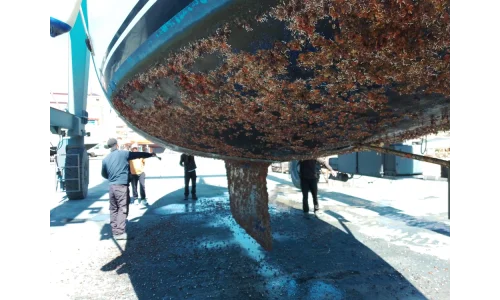
A morning coffee, a few sighs of relief, and it was time to head to the boatyard. By ten in the morning, the Azul was out of the water. It had a whole reef stuck to the hull. Our time in San Gabriel was still taking its toll.
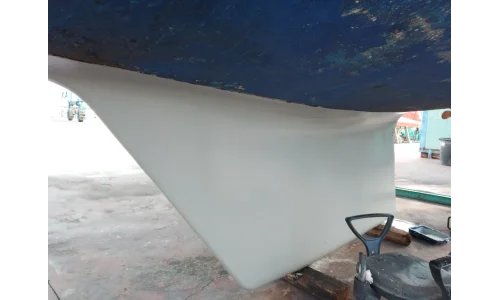
The haul-out lasted twelve days: cleaning, checking the shaft, rudder, propeller, seacocks, replacing anodes, fresh paint, and work on the keel. A thorough sanding to confirm its condition was outstanding. And it was. Everything was in place, solidly built.
By day, work. By night, exhausted, we rested aboard the Judith.
The time came to return to Tomás Maestre. The Azul, back in the water. A priming of the dry gland and a goodbye from the boatyard workers — all friendly, all lending a hand with whatever was needed. The voyage back was calm, uneventful. In a few hours, the Azul — all handsome, gleaming with new paint — was back at its mooring.
Twelve days out of the water. Twelve days of work, of laughs with Miguel, of nights curled up in the Judith. And a scare at four in the morning that reminded us the sea never lets you get too confident.
But that's what it's all about, I guess. Learning. Keeping on sailing.
Note from the crew
This English version was translated automatically using small, local AI models during our voyage, often without an internet connection. It may contain small errors or quirks. The original Spanish version is the definitive one. We appreciate your understanding — and if you speak English and spot something that could be improved, we'd love to hear from you.