The Mar Menor: School and Refuge
Our playground, our testing ground. We left the Tomás Maestre at the beginning of August. We wanted to spend a few days anchored in the Mar Menor; those days turned into three months. Time flew. It was a great school: life with the dinghy to go get water and supplies, anchoring and weighing anchor almost every day, with one or two, depending on the circumstances.
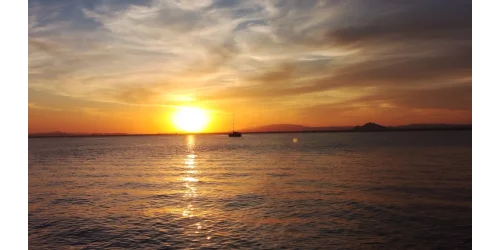
It was a period of disconnection from land. Life on the Tomás Maestre had been intense and very social; many great friends remained there, and they would always be in our memories, but we appreciated the rest: the two of us, the Azul, the sea, and the stars.
A grand end to summer. The day passed between searching for the best anchorage and taking our baths. Land excursions to visit the small coastal towns: Los Nietos, Playa Honda, Los Urrutias, Los Alcázares, Santiago de la Ribera. Whatever we didn’t do on land, we did now by sea, far more exciting.
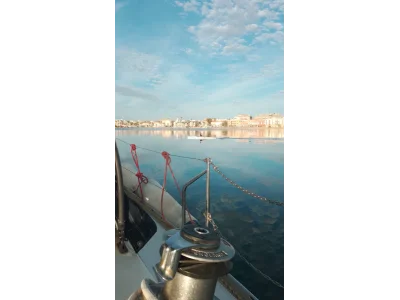
Although it was a controlled area, we were alone. If easterly winds blew, we went to anchor seeking shelter in the bay; if westerly winds blew, we went to the other shore, leeward of land.
Autumn was approaching, and we had to leave. The meteorology began to issue warnings, the days were getting shorter, and the solar system was already in deficit; we needed to start the engine to maintain the batteries.
And in October, a great east wind storm arrived. The warnings were for strong winds, and we experienced them: gusts of 50-60 knots. We, facing the Tomás Maestre. Two anchors at the bottom and the Azul remained there, firm. We didn’t move. Everything went well, but it wreaked havoc in the harbor and on the western shore. The next day, we saw the consequences: streetlamps and trees down, sails torn, and more than one scare, as they told us later. It was an uneasy night, a watch, but we stayed there.
One day, on the way to an anchorage where we’d been before, we ran aground. The bottom had been moved by the storm: where there had been five meters, now there was only one. The first thing was the scare; the second, thinking how to get out of there. What if we tried to tow with the dinghy? What if we waited for someone to give us a pull? Or, lastly, called a friend in the harbor to help us. However, suddenly it came to me the anecdote a professor told us about running aground with his merchant vessel in the estuary of Huelva: “Steer to one side, ahead; to the other side, astern. Move the tail —he said— side to side, widen the channel.” And it worked. A Galician sailor with a bad temper, but good in his lessons.
The fishermen of the coastal towns were starting their season. Anchoring, which had been a luxury in the entire Mar Menor, became complicated: the nets now occupied the places where we had anchored days earlier. Everything suggested that this phase was ending.
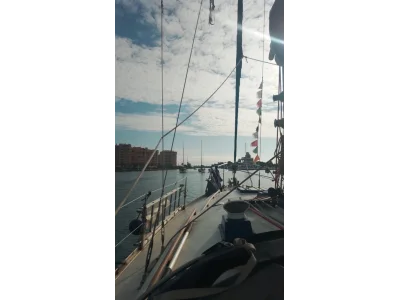
Thus, at the beginning of November, after waiting for favorable weather, we crossed the Estacio Channel and entered the Mediterranean. Tomás was waiting to see us off; the drawbridge, slowly and heavily, began to open, and we, finally, left our playground, heading toward Almerimar.
One stage ended and another was about to begin. 130 nautical miles separated us from our destination. Melilla had already been ruled out: we didn’t have space.
The memories remain with us: the friends, the sunsets and sunrises —undoubtedly one of the most beautiful we’ve ever seen— came with us. There’s no doubt we will return.
And so, with the wind at our back, we closed that passage.
Note from the crew
This English version was translated automatically using small, local AI models during our voyage, often without an internet connection. It may contain small errors or quirks. The original Spanish version is the definitive one. We appreciate your understanding — and if you speak English and spot something that could be improved, we'd love to hear from you.