Bound for Almerimar, a Pleasure Voyage
We had been in the Mar Menor for a few months, anchored day after day, swaying in that dead calm of the inland sea, when the time came to set sail. It was early November and we had already weathered a couple of storms — the kind that make you wonder what the hell you're doing on a boat. We couldn't put it off any longer. The forecast for the following week was good: light wind, blowing off the land. Or, as Tomás would say, sun and flies.
130 miles. In a day and a half we'd be there, but we had another plan in mind: sail by day and, come evening, look for an anchorage if conditions allowed. So at first light, with the first opening of the Estacio bridge, we set out into the Mediterranean on a south-southwest heading. One last farewell to Tomás, who was waiting for us at the start of the channel. See you soon, La Manga.
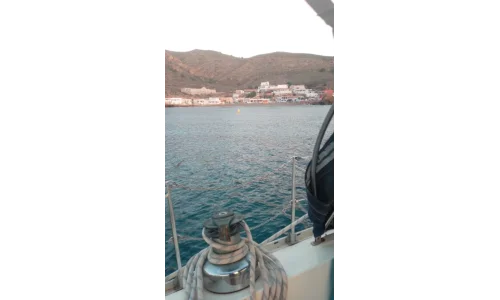
Light wind. Engine on, main sail up. That would be the rhythm of the voyage.
By noon we rounded Cabo de Palos on a sea as flat as a mirror. We spent the day taking in the landscape — which around these parts is truly beautiful — snacking, letting the Azul glide along peacefully. We passed Cartagena and the afternoon began to fade. If we wanted to anchor, it was time.
We had spotted Cala del Portús on the chart: a small village, a nudist campsite, clear waters. That's where we dropped the hook. First we had to cross the waiting zone for cargo ships, anchored over hundred-meter depths in the shelter of Cabo Tiñoso. We, on the other hand, sought the shallow, the near, the intimate.
It was the right call. The cove was small, barely a whisper of a beach, but the water had that virgin Mediterranean clarity. We cut the engine. Silence. Just the gentle lapping against the hull. We had a good dinner, with wine, with that light that fades slowly behind the cape. There we stayed, Eli and I alone, the Azul rocking softly and Cabo Tiñoso up above, enormous, silent, watchful. A luxury.
We slept with one eye open, as always, but everything went well. At dawn, a proper breakfast: coffee, toast, eggs and bacon. Batteries recharged, we weighed anchor and crossed the sleeping fleet of merchant ships again. We passed near the cape, where the coast juts into the sea, so we kept some distance, though never losing sight of it.
We sailed past Mazarrón and Águilas. The sea was scattered with floating reeds; a recent storm in the east had washed down everything the dry riverbeds had swept along their paths. We could have anchored inside Águilas harbor — they say it's allowed — but we were making good progress and decided to push on. Playa de las Palmeras was the target, a bit to the south.
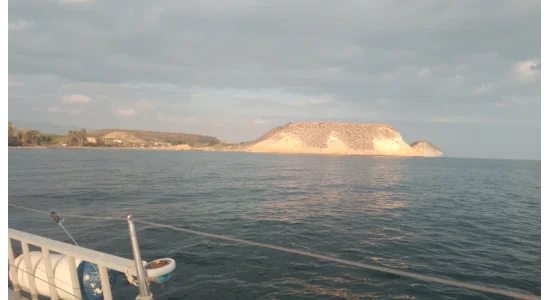
The landscape changed: more desert-like, palm trees silhouetted against a blue sky, the N332 highway passing close by but not bothering us. This time it wasn't a closed cove, but an open bay, and we felt more at ease. A few bathers on the beach; us facing landward, the breeze coming down from the coast. No other boat in sight. A quiet dinner, a couple of beers, the sound of waves breaking in the distance. The Azul, a trooper. And us, privileged.
Again the morning ritual: a big breakfast on board, weigh anchor, and set course for Las Negras. That's where we wanted to spend the night.
Done and dusted. A calm coastal sail, no rush. By sunset we were anchored off the village. Anyone who knows Cabo de Gata knows how beautiful it is; for us it has always been a special place. Seeing it from the sea, from the other side, felt like discovering it for the first time. Another memorable dinner, another luxury stolen from time.
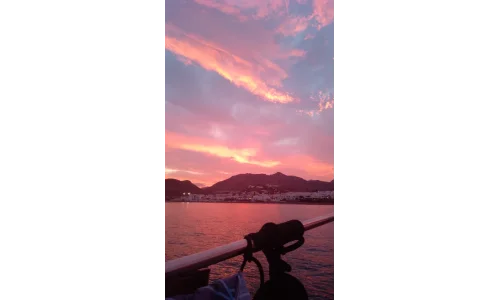
The forecast called for easterly winds by mid-morning the next day. We decided to set sail early to take advantage of it and gain ground south. In fact the wind was blowing from the northeast, which made it impossible to anchor at Playa de los Genoveses — that tongue of sand we've always loved so much — before rounding the cape. We gave it a try, but there was a boat there dancing like a possessed thing. We took a look, confirmed the obvious, and carried on.
We rounded Cabo de Gata. The village, on the leeward side, offered us a spacious, easy, calm anchorage. The wind respected us. Our journey was coming to an end. Only the crossing of the Gulf of Almería remained: 30 miles. The forecast was worsening for the following late afternoon and evening, but we were practically there already.
Dawn broke. Breakfast. Bow to the south.
By mid-afternoon we were entering the mouth of Almerimar harbor. We stopped at the waiting dock, they assigned us a berth, and on top of that they let us choose. We adjusted the lines so the Azul's departure would be easy. These small details mean everything.
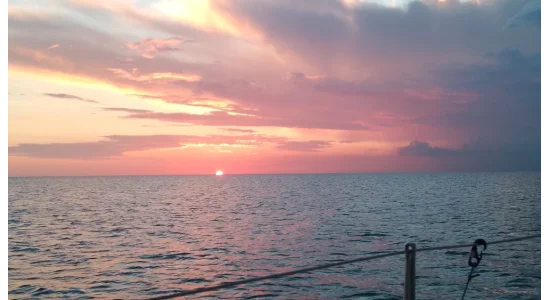
Docked. Engine off. Silence again, but different: the silence of solid ground.
We went to celebrate the arrival. And right then the storm began: rain, wind, the sky opening up above us. Inside there, sheltered, watching the water soak everything, we smiled.
The Azul was safe. So were we.
Almerimar would be our home for the whole winter. A transient port, many foreigners, but welcoming. There we stayed, watching the months pass, until the time came to dream again of the next passage.
Note from the crew
This English version was translated automatically using small, local AI models during our voyage, often without an internet connection. It may contain small errors or quirks. The original Spanish version is the definitive one. We appreciate your understanding — and if you speak English and spot something that could be improved, we'd love to hear from you.